The Unchanging Tradition Is a Story We Tell Too Easily
Rural tradition is not simple repetition. See how customs keep their meaning as people adapt the words, materials, and roles they pass on.
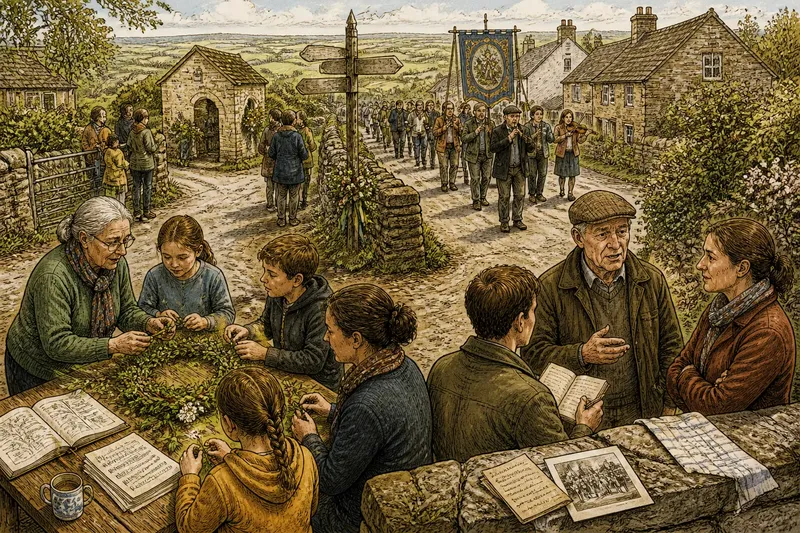
Rural tradition can look unchanged from the lane: the same procession turns the same corner, or the same tune opens a local gathering. Look closer and the people, materials, and reasons may have shifted. A custom lasts not because every detail stays still, but because people keep deciding what is worth carrying forward.
Continuity is not repetition. These five distinctions help explain how customs change without becoming meaningless.
1. What stays continuous when a custom changes?
A tradition is often described by its visible actions: a route, a song, a shared task. But its continuity may lie elsewhere—in the relationships it renews, the season it marks, or the obligation it makes visible. A custom can alter its outward form while retaining one of those purposes.
Imagine a parish procession whose usual route becomes inaccessible after a footpath closes. Organizers choose a nearby lane, explain the change, and invite participants to pause at the old meeting point. The route differs, but the gathering still links neighbors to a familiar place and to one another. The observable result is a custom people can continue, with its alteration made part of its local account.
That does not mean any change preserves the same tradition. If the central purpose disappears, calling the new activity by the old name may conceal a real break. Asking what participants understand the custom to do is more revealing than comparing appearances alone.
2. Why does repetition make the past look tidier?
Repeated actions can acquire the appearance of permanence. A familiar arrangement is easy to remember as “how it has always been,” particularly when each generation learned it from the people immediately before them. Memory tends to preserve a workable outline, not a full record of every adjustment.
Small changes can pass without ceremony. A tune is shortened because fewer singers know all its verses; a shared task is rearranged because the people available have changed. Later, the adapted version may be remembered as the original. This is not necessarily dishonesty. It is one way a community turns an untidy history into a usable story.
Oral accounts can still preserve useful clues. Listen for differences in wording: “we used to,” “my aunt changed,” or “the children now.” Such phrases reveal that participants already recognize a custom as something shaped over time, even when they also describe it as old.
3. What changes as people pass a custom on?
Transmission is an active process. Someone chooses which part to teach, what to explain, and what can be left for newcomers to discover. A person showing children how to weave a simple wreath may keep the pattern but use locally available materials instead of the ones used by older relatives. The practice remains legible, while its materials reflect present conditions.
Words and roles change, too. A verse may be translated or replaced if its meaning has become obscure. New participants may take on tasks once reserved for a particular household. Those adjustments can widen access, but they can also unsettle people who understand the old arrangement as part of the custom’s meaning.
It helps to distinguish an inherited detail from a required one. Ask who taught it, what reason they gave, and whether people today attach the same significance to it. Keep the explanation alongside the practice; otherwise, the adaptation may be remembered while the choice behind it disappears.
4. Who gets to say a custom has changed?
There is rarely a single, neutral observer. A long-standing participant may notice the loss of a familiar verse. A newcomer may see that the gathering has become easier to join. Someone responsible for organizing it may focus on what can be managed with the time and people available. Each account describes a different part of the custom.
Disagreement is not automatically evidence that a tradition has failed. It can show that people care about different elements: the original wording, the shared effort, the place, or the chance for younger participants to learn. A useful conversation names those elements rather than treating “authentic” as a verdict that ends discussion.
Keep older accounts available without requiring every new participant to reproduce them exactly. A handwritten song sheet, a family explanation, or a note about a changed route can show what was altered and why. Such records document choices, not a single authorized version.
5. How can a community adapt without pretending nothing changed?
Honest continuity makes room for a clear account of change. People can name what remains important, what has been altered, and what they do not know about the custom’s earlier form. This is more accurate than calling every version ancient, and more generous than treating every revision as a betrayal.
For a local custom under discussion, participants might use questions such as these:
- Which action or purpose do people most want to preserve?
- Who has taught the custom, and whose account is missing?
- What practical change has already occurred?
- Does the change affect participation or the meaning people attach to it?
- How can the decision and its reasoning be remembered?
The answers need not produce unanimous agreement. They can make a change understandable, which matters when future participants inherit both the practice and the story told about it.
What do readers ask about rural tradition?
Does a changing custom stop being a tradition?
Not necessarily. A custom can continue through changed wording, materials, or roles if participants still recognize and pass on something meaningful. When its central purpose or shared understanding disappears, the name may persist even as the practice becomes something different.
How can someone tell which parts are old?
Compare accounts from different participants and ask what each person learned directly, rather than assuming one version is definitive. Local notes, song sheets, and family recollections can help, but gaps in the record should remain visible rather than being filled with confident guesswork.
Why do people disagree about preserving a custom?
They may value different parts of it: its wording, place, social role, or the way it brings people together. A disagreement often becomes clearer when people describe what they want to retain instead of arguing over whether one version is the only authentic one.
Can a new custom become a local tradition?
Yes, if people take it up, give it shared meaning, and pass it on. Longevity alone does not explain why a practice matters; repeated participation and the account attached to it help make it part of local life.
Rural tradition is easiest to understand when its changes are neither hidden nor mistaken for failure. Ask what people are carrying forward, and let them say plainly what they have altered. The next generation can inherit a practice and a truthful account of how it came to be.