Village Hall or Church Room for a Community Gathering?
Compare a village hall or church room for your community gathering, with clear ways to weigh atmosphere, access, facilities, and the occasion itself.
Choosing a village hall or church room for a community gathering often comes down to a question that sounds simple until the chairs need moving: what should the room make possible? A village hall tends to offer a flexible, civic setting; a church room often carries a quieter sense of continuity and place. Neither is automatically the better choice. The useful choice is the one that fits the occasion and the people expected to attend.
What does each room suggest before anyone arrives?
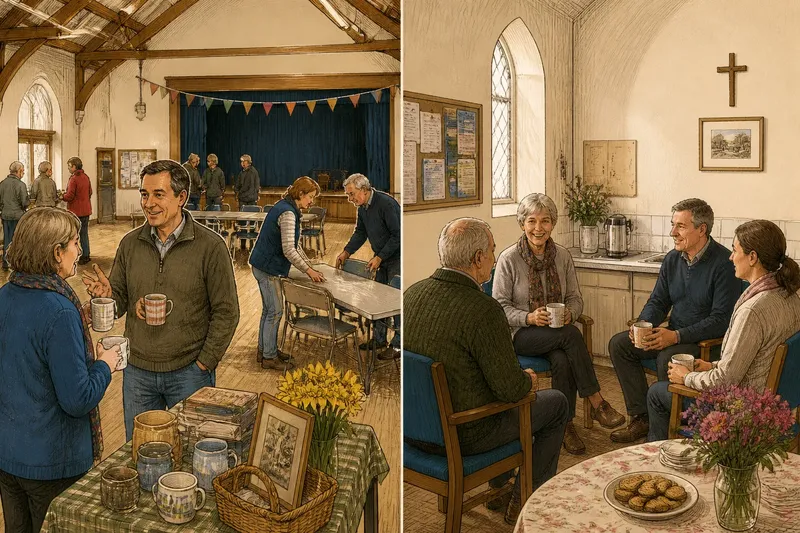
A village hall usually announces its purpose plainly. It is a shared local room, used for meetings, classes, dances, fundraisers, and the occasional table laden with raffle prizes. Its character comes less from a single institution than from the many groups that use it. That can make it feel open to a broad mix of neighbors.
A church room may be part of a church complex or a separate parish room, but its connection to the congregation is often visible in the setting. There may be a noticeboard, a small kitchen, familiar religious imagery, or a long-standing association with local events. For some guests, that history is welcoming. Others may assume, wrongly, that an event is only for church members unless the invitation makes its open nature clear.
Consider the first impression you want to make. A public meeting about a shared lane may sit naturally in a village hall. A quiet remembrance gathering may feel more at home in a church room. These are tendencies, not rules; the room’s layout and the hosts’ welcome matter more than the name on the door.
Which space fits the shape of the occasion?
Village halls commonly have a large, unobstructed room that can be arranged for different uses. That suits a ceilidh with room for dancing, a jumble sale with trestle tables, or a talk where guests need a clear view of a speaker. Some halls have a stage, storage cupboards, or a separate kitchen. Others are a single room with folding chairs and a sink. Ask what is actually available rather than relying on the building’s name.
Church rooms are often smaller and more intimate, though there is no standard design. A compact room can help a reading group or a parish discussion feel like a conversation rather than an audience. A larger church hall may support a substantial social event just as comfortably as a village hall. The relevant question is not which room is theoretically grander, but whether its shape fits the way people will spend their time.
Say you are arranging a local-history talk followed by tea. Imagine the church room has comfortable seating already in place and a kitchen close by, while the village hall has a broad floor and a stage but needs furniture rearranged. The church room may suit a small, conversational audience; the hall may make more sense if attendance is uncertain or you want space for a display. The expected result is a gathering whose layout supports its main activity, rather than a room that spends the evening being worked around.
Sketch the event on paper: where people enter, sit, speak, eat, and leave. A rough plan exposes awkward bottlenecks before they become a committee’s favorite topic.
How should you compare access and facilities?
Access is more than whether a building has a ramp. Check the approach from the road or parking area, the entrance threshold, door width, toilet arrangements, lighting, and whether the route between the main room and kitchen is manageable for your guests. If anyone has particular access needs, ask them what would help rather than guessing from a building description.
Facilities can quietly decide whether a room is practical. For food, find out whether the kitchen is available and what equipment is included. For a talk, ask about chairs, tables, a screen, and power points. For an evening event, check the heating controls and the process for locking up. Some venues provide a caretaker; others expect the organizer to handle opening and closing. The arrangement should be clear before the invitation goes out.
Availability and hiring conditions also vary. A village hall may be managed by a committee or trust, while a church room may be booked through a parish office or local contact. Ask about permitted activities, setup time, cleanup expectations, and how cancellations are handled. For requirements that depend on venue policy, local rules, or equipment instructions, follow the relevant guidance rather than assuming the other room works the same way.
Who is each setting likely to suit?
A village hall often suits an event that needs room to change shape: a community forum with breakout conversations, a craft sale with several stalls, a seasonal dance, or a gathering where guests may come and go. Its shared civic character can help signal that people do not need a particular affiliation to attend. It can also feel rather bare until the hosts add a little care.
A church room often suits a smaller gathering where conversation, reflection, or an existing parish connection is central. It may be a natural choice for a church group, a local history circle, or neighbors meeting after a service. If the event is intended for the whole village, make that welcome explicit in the notice and at the door. Inclusion is partly a matter of practical access and partly a matter of not making newcomers decode the room.
Neither setting owns a particular mood. A village hall can host a solemn remembrance; a church room can host a lively fundraiser. Let the occasion lead, then consider which venue makes its purpose easiest to understand.
What should you ask before booking either room?
Can everyone reach and use the main room?
Ask about the full route from arrival to seating and toilets, not only the front entrance. If guests have differing mobility, hearing, or sensory needs, speak with them and the venue contact about workable arrangements.
What furniture and equipment are included?
Confirm the number and type of chairs, tables, kitchen access, and any sound or display equipment. Knowing what is already on site helps you avoid planning around facilities that are locked away or unavailable.
How much setup and cleanup time is available?
Find out when organizers can enter, who moves furniture, and what must be returned to its usual place. A room that fits the event may still be a poor choice if the available time does not fit the setup.
How will the venue feel to someone attending for the first time?
Check whether the entrance is obvious, whether signs are needed, and whether the invitation explains who is welcome. A friendly room is easier to enter when a new guest does not have to guess if they are in the right place.
How can you make the choice without overthinking it?
Start with the event’s main activity, then set aside the features that do not matter. If people need open floor space, prioritize layout. If the gathering depends on quiet conversation, look for a room where people can hear one another without raising their voices. If guests are unfamiliar with the venue, clear access and a visible welcome may matter more than a stage or an attractive noticeboard.
Then compare the actual rooms, not the idealized versions. Ask to see each space if possible, or request a current description of its layout and facilities. A quick conversation with the person who opens the building can reveal practical details that a booking form leaves out, such as where coats go or whether the kitchen door is kept locked.
For a community gathering, the village hall or church room is not merely a backdrop. It shapes how easily people arrive, settle, take part, and leave. Choose the room that supports those ordinary movements, and make the invitation clear enough that every expected guest knows there is a place for them.