Why a Village Green Has More Than One Use
Why a village green has more than one use: see how paths, play, quiet routines and seasonal events shape a shared place through repeated use.
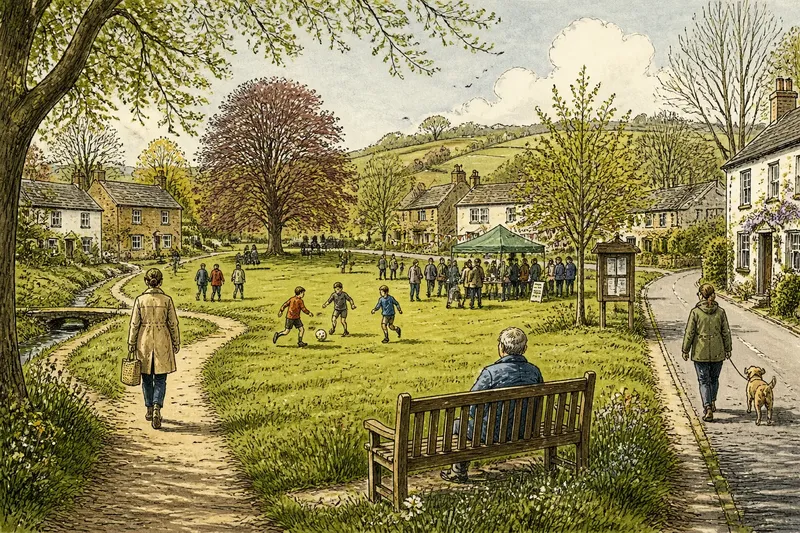
Why a village green has more than one use? On a weekday morning, someone may cross it on the way to the shop; later, children may kick a ball across the same grass, and at dusk a dog walker may take the quieter edge. A green does not need a new design for each activity. Its character grows from the repeated ways people occupy it, and from how those uses make room for one another.
What counts as a village green?
A village green is a shared open space within or beside a settlement, but its appearance and formal status vary. It might be a broad lawn with a road around it, a small triangle at a junction, or a rough piece of ground beside cottages. Some greens have benches, trees, a noticeboard or a path. Others are mostly grass, with boundaries that are easier to recognize on foot than on a map.
The familiar image of a neat central lawn can be misleading. A green may be irregular, edged by a stream, crossed by a worn track or partly shaded by old trees. What makes it socially legible is not a particular plan but the sense that people can be there without needing a special invitation. A public notice, a parish map or a local authority record may clarify ownership and access; the visible landscape alone does not always settle those questions.
That distinction matters because “shared” describes a social expectation as much as a physical arrangement. People may treat a space as common ground because generations have crossed it, paused there or gathered there. Formal rights and everyday custom can overlap, but they are not interchangeable.
How can one green serve different purposes?
Its uses often shift with the hour. A quiet morning may suit a short walk, a bench and a conversation. At school-run time, the space can become a route, with people cutting across the grass rather than following the road. In the afternoon, children may use an open patch for informal play, while a shaded edge remains useful to someone who wants to sit apart.
Seasons change the pattern too. In warmer weather, people linger outside; in wet spells, the firmest paths matter more than the open center. A tree can offer shade in summer and a clear view across the green after its leaves fall. A village event might use only one portion, leaving a route through the rest. The place remains useful because its parts need not be occupied in the same way at once.
Say a small green has a bench near the road, a broad patch of grass and a path along one side. If a volunteer group places a temporary notice asking visitors to keep a clear route during an evening gathering, people can still cross the green while the event takes place. The observable result would be two activities sharing the space rather than one taking it over.
Use is also shaped by the people who are present. A space that feels welcoming to a dog walker at one hour may seem busy to someone seeking quiet later. That does not make either use improper. It means the green works through informal negotiation: people notice one another, adjust their routes and leave room where they can.
Why does repeated use shape a green’s meaning?
Repeated use gives an ordinary feature a local role. A gap between two trees may become the customary crossing because people have taken that line for years. A low wall may serve as a place to sit, even if no one designed it as a bench. The meaning is practical before it is symbolic: people learn where a route leads, where a pause feels comfortable and which parts are suited to play.
Over time, those habits become part of how residents explain the place. Someone might give directions by the old oak or say that the children meet near the noticeboard. These references make the green familiar without turning every habit into a formal tradition. They also help newcomers understand how the space is used, especially when there are no signs to explain it.
Repetition does not mean that customs never change. New residents may use a path differently, an old gathering may stop, or a bench may be moved. The green’s meaning shifts as people adapt. A place can retain its identity while its daily routine changes, provided people continue to recognize it as shared space rather than as scenery reserved for looking at.
Notice which parts people return to, not only what the green contains.
How do paths, edges and open ground affect use?
Small physical details can make different activities coexist. A path gives walkers a predictable route and can reduce the temptation to cut through a muddy patch. A tree line offers shelter and a boundary without closing off the view. A bench at the edge lets someone rest while leaving the center available for movement or play.
Open ground matters for the opposite reason: it does not prescribe much. A clear patch can support a ball game, a picnic blanket or simply an unobstructed crossing. That flexibility can be useful, but it also invites negotiation. A group using the center may need to notice people passing through, while a person crossing may choose the edge when the middle is occupied.
Edges often carry more than one purpose. A low hedge or shallow ditch can mark a limit, support local plants and help distinguish the green from the road. Yet a dense barrier may make a corner feel cut off. The right balance depends on how the space is reached and used. A familiar entrance can be as important as the broadest patch of grass.
Maintenance influences these choices without determining them completely. Mown grass may make a space easier to cross; a less closely cut strip can support flowers and insects. A worn track can show where people already go, but it may also become slippery or muddy. Local caretakers and residents often have to weigh practical access, appearance and habitat rather than expect one treatment to satisfy every purpose.
What should residents consider when uses compete?
Start by describing the conflict plainly. “The green is getting too busy” is difficult to act on; “the ball game crosses the path used by people walking through” identifies the particular friction. Clear descriptions keep a disagreement from turning into a judgment about who belongs there.
Then look for a modest adjustment that preserves access. A sign can identify a preferred route during an event. A gathering can be placed toward one side rather than across the main crossing. A group may agree to avoid a particular corner at a busy time. These are not universal solutions; they are small choices that can be discussed with the people who use the space.
It can help to distinguish between occasional inconvenience and a persistent barrier. A lively afternoon may briefly change how someone crosses the green. A regular obstruction at an entrance may make the space harder to use every day. Ask who is affected, what activity is taking place and whether an adjustment would leave the other use possible.
Where the green has formal restrictions, local rules or an organized custodian, check those before changing fixtures, posting signs or arranging an event. A parish council, local authority or land manager may be the right contact, depending on the place. For ordinary daily use, considerate behavior and a conversation with neighbors may be enough; for a recurring dispute, an agreed local process is more useful than an argument over whose custom is oldest.
What do visitors often want to know about village greens?
Can anyone walk across a village green?
Often, people are accustomed to crossing a green, but access depends on its location, ownership and any local restrictions. Follow posted notices and use established paths where they exist.
Is a village green the same as a village common?
The terms can refer to different kinds of land and may carry different legal meanings. In everyday speech they can overlap, so a local record is more reliable than the name alone.
Can a village green be used for an event?
Many greens host occasional public or local activities, but permission may be needed, particularly for equipment, vehicles or temporary structures. Ask the relevant land manager before making arrangements.
Why do people keep using an informal path across the grass?
It may be the most direct or comfortable route between two everyday destinations. If the path causes damage or becomes difficult to use, residents can consider a clearer route that still follows how people move through the space.
How can you read a green without assuming too much?
Spend a little time noticing its rhythms. Look for the main crossings, the places where people stop, the parts that stay quiet and the corners that change with weather or season. A single visit shows only one moment; the same green can feel different when school is out, when rain has softened the ground or when an event occupies part of the lawn.
Pay attention to what is absent as well. A bench may be missing where someone would need a pause; a path may end short of the entrance people actually use. A space can look open yet be awkward for a person carrying shopping, pushing a stroller or walking with limited mobility. Those details are easier to discuss when described concretely rather than treated as a general impression.
Why a village green has more than one use is ultimately a question about habits, not just layout. Its routes, meeting points and quieter corners gather meaning as people return to them, while the land continues to accommodate new routines. If you want to understand a particular green, notice who uses which part, at what time, and what small adjustments allow others to use it too. That is a more reliable guide than any single photograph of an empty lawn.